
Last checked: September 19, 2026. Shopify pricing, payment rates, and promotional offers can vary by country and can change over time. The prices below use current U.S. pricing where available.
Shopify is one of the most established hosted ecommerce platforms for businesses that want to sell online without managing web hosting, server updates, or a separate ecommerce plugin stack. In this Shopify review for 2026, we look at the parts that matter most when choosing an ecommerce platform: pricing, payment and transaction fees, store management, themes, apps, analytics, point of sale, international selling, AI features, limitations, and who each plan is best suited for.
On this page
- Shopify review 2026: quick verdict
- Shopify pricing in 2026
- What you get with Shopify
- Ease of use and store setup
- Themes, design, and customization
- Products and inventory management
- Shopify Payments and transaction fees
- Checkout and conversion tools
- Multichannel and international selling
- Shopify POS for physical retail
- Apps and integrations
- Shopify SEO and content management
- Analytics and reporting
- Shopify AI features in 2026
- Hosting, security, and maintenance
- Shopify support
- Shopify pros and cons
- Shopify vs WooCommerce and WordPress
- Who should consider Shopify?
- Who may prefer an alternative?
- Which Shopify plan should you choose?
- The real cost of Shopify beyond the subscription
- Shopify review FAQ
- Final verdict
Shopify review 2026: quick verdict
Shopify is a strong fit for merchants who want a hosted commerce platform with payments, inventory, checkout, multichannel selling, analytics, and an extensive app ecosystem under one account. The trade-off is that the total cost can rise above the base subscription once you add paid apps, premium themes, POS Pro, or third-party payment processing.
For a new online store, the Basic plan is usually the logical starting point. Grow becomes more relevant when a team needs staff accounts and lower payment fees, while Advanced is aimed at larger or more international operations that can justify the higher subscription cost. Shopify Plus is a separate enterprise-level decision rather than a normal upgrade for a small store.
Shopify pricing in 2026
Shopify currently lists Basic, Grow, Advanced, and Plus as its main store plans. As checked on September 19, 2026, the official Shopify pricing page shows lower effective monthly prices when billed annually. Shopify is also advertising a limited introductory offer after its free trial, but promotional terms can change, so the standard plan price is the more useful number for long-term budgeting.
| Plan | Annual billing | Monthly billing | Online card rate from | Third-party transaction fee | Additional staff accounts |
|---|---|---|---|---|---|
| Basic | $29/mo | $39/mo | 2.9% + 30¢ | 2% | None |
| Grow | $79/mo | $105/mo | 2.7% + 30¢ | 1% | Up to 5 |
| Advanced | $299/mo | $399/mo | 2.5% + 30¢ | 0.6% | Up to 15 |
| Plus | From $2,300/mo on a 3-year term | From $2,500/mo on a 1-year term | Varies by agreement and market | Lower than core plans | Unlimited |
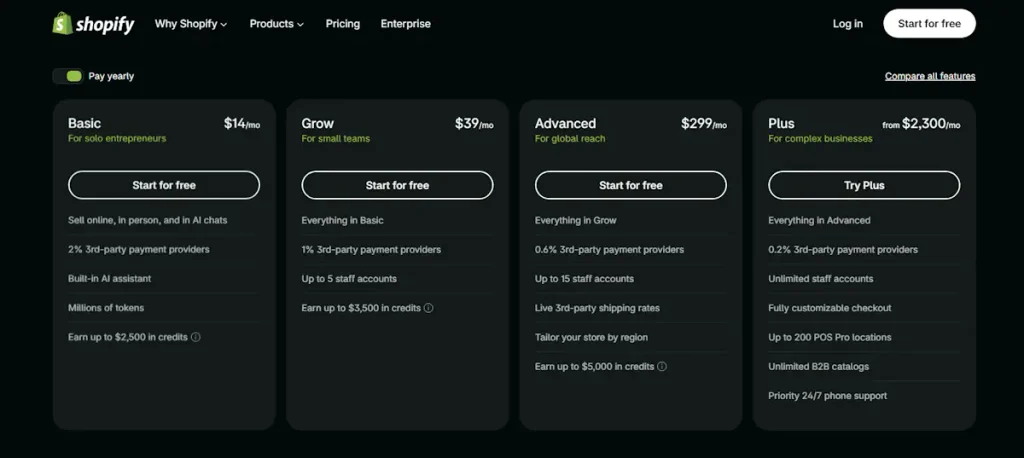
Shopify’s current pricing page also lists 10 inventory locations for Basic, Grow, and Advanced. Plus supports a much larger operating footprint and additional enterprise controls. If you are comparing plans primarily on cost, do not look only at the subscription: payment fees, apps, themes, POS, shipping tools, tax services, and development work can change the real monthly total.
What the introductory offer means
At the time of this review, Shopify advertises a three-day free trial followed by a promotional period at $1 per month for three months on eligible plans. Treat that as a temporary onboarding promotion rather than the normal cost of running the store. Your long-term comparison should use the standard price you expect to pay after the promotion ends.
What you get with Shopify
The main advantage of Shopify is that it packages most of the core ecommerce infrastructure into one hosted service. Shopify’s product and feature catalog brings hosting, SSL, product management, checkout, orders, inventory, customer records, discount tools, analytics, sales channels, and payment integrations into the same platform.
- Hosted online store with SSL included
- Unlimited products on the core plans
- Inventory management and multiple inventory locations
- Shopify Payments where available
- Built-in checkout and fraud-analysis features
- Discounts, gift cards, customer segments, and marketing tools
- Sales across social channels and marketplaces
- Point-of-sale support for in-person selling
- Analytics and reporting
- Theme and app ecosystems
- AI-assisted tools including Sidekick and store-building features
- International selling features that become more advanced on higher plans
Ease of use and store setup
Shopify removes several technical jobs that would otherwise sit with the site owner: server configuration, SSL setup, core ecommerce software updates, and the basic hosting stack. That makes it easier to launch a store than assembling hosting, WordPress, WooCommerce, a payment gateway, caching, backups, and security tools separately.
The admin is organized around products, orders, customers, content, analytics, marketing, discounts, apps, and sales channels. A first-time merchant still has work to do — products need clean data, shipping rules need testing, taxes need reviewing, and the checkout needs to be verified — but the platform reduces the amount of infrastructure work required before the first sale.
Themes, design, and customization
Shopify stores can use free or paid themes from the Shopify Theme Store, with additional customization through the theme editor and Shopify’s Liquid templating system. The theme ecosystem is more controlled than an unrestricted WordPress installation, which can be helpful for consistency but also means deep custom work often requires Liquid, custom sections, an app, or a developer.
For many small stores, a well-configured theme is enough. Businesses with unusual merchandising flows, complex content structures, or heavily customized storefront experiences should budget for development rather than assuming every requirement can be handled with theme settings alone.
Products and inventory management
Shopify is built around commerce operations, so product and inventory management feel native rather than added on later. Merchants can manage variants, pricing, inventory quantities, collections, product media, shipping information, and multiple inventory locations. The core plans currently include 10 inventory locations, which is enough for many smaller operations.
The platform also supports selling across multiple channels, so inventory can be coordinated across the online store and other connected sales channels. For businesses with specialized warehouse workflows, subscriptions, bundles, advanced returns, or niche fulfillment requirements, the final workflow may depend on apps or external systems.
Shopify Payments and transaction fees
Shopify Payments is the cleanest payment path where it is supported. Shopify states that eligible orders processed through Shopify Payments avoid the additional third-party transaction fee. You still pay the applicable card-processing rate for the plan.
If you use a third-party payment provider instead of Shopify Payments, Shopify can charge an additional transaction fee. On the current U.S. pricing table, those fees are 2% on Basic, 1% on Grow, and 0.6% on Advanced. Plus has different enterprise pricing. This is one of the most important costs to check before choosing Shopify in a country or business model where Shopify Payments is not the payment method you intend to use.
Payment rates also vary by country, card type, and plan. The headline rate should therefore be treated as a starting point, not a universal rate for every transaction.
Checkout and conversion tools
Shopify Checkout is a major part of the platform’s value proposition because it is maintained as a core platform component rather than something each merchant has to build from scratch. Express payment options, Shop Pay, discount logic, customer information, fraud-related tools, and order processing are integrated with the rest of the system.
That integration is useful because checkout reliability and payment compatibility are difficult areas to maintain independently. At the same time, the degree of checkout customization depends on the plan and the type of customization. Shopify Plus offers substantially more control for enterprise use cases.
Multichannel and international selling
Shopify can connect a merchant’s catalog to social platforms, marketplaces, in-person sales, and other channels. It is increasingly positioning the platform around commerce beyond the traditional online storefront, including AI-assisted discovery and shopping channels.
International selling features are available across the platform through tools such as Shopify Markets, while Advanced adds more region-specific control. Merchants selling across multiple markets should still review currencies, domains, duties, taxes, payment availability, local pricing, and fulfillment rules for each target country rather than assuming one configuration fits every market.
Shopify POS for physical retail
Shopify POS supports in-person selling on Shopify store plans, while POS Pro is a paid add-on for retailers that need more advanced store operations such as richer staff permissions and in-store workflows. This is especially relevant for businesses that sell both online and in a physical shop, at events, or through pop-up locations.
POS pricing is another cost to include in the budget. A merchant running several physical stores can spend materially more than the online subscription alone once POS Pro locations and hardware are included.
Apps and integrations
The Shopify App Store is one of the platform’s biggest strengths because it lets merchants extend areas such as email marketing, subscriptions, loyalty, reviews, bundles, shipping, accounting, customer service, upsells, print on demand, dropshipping, and reporting.
The downside is cost and dependency. A store that needs five or ten paid apps can end up with a recurring software bill much higher than the Shopify plan itself. Apps can also overlap, inject storefront code, or create operational dependencies. Before installing an app, check whether the function is already available natively and whether the recurring cost is justified.
Shopify SEO and content management
Shopify covers the technical SEO basics expected from a modern hosted ecommerce platform: editable page titles and meta descriptions, canonical handling, XML sitemaps, redirects, structured product data, mobile-responsive themes, and secure hosting. Shopify also maintains an official SEO guide, and store owners can create pages and blog content.
The main limitation is flexibility compared with a content-first CMS such as WordPress. Shopify is designed primarily around commerce, so publishers that need complex editorial taxonomies, highly customized content types, or advanced content workflows may find WordPress more flexible. That does not mean Shopify cannot rank; it means the content model is less open-ended.
Analytics and reporting
Shopify includes reporting and analytics across the core plans, with more advanced operational capabilities as the business moves up the plan ladder. Its reports and analytics tools can help merchants monitor sales, products, customers, marketing, and store performance without building a reporting stack from scratch.
For larger businesses, Shopify data is often combined with external analytics, advertising platforms, accounting systems, customer-data tools, and business-intelligence software. Native reporting is useful, but it should not be mistaken for a complete enterprise analytics strategy.
Shopify AI features in 2026
AI has become more visible inside Shopify. The current plans page highlights Shopify Sidekick, AI-assisted website building, and large token allowances as included platform features. Shopify is also expanding commerce into AI shopping channels.
These tools can reduce repetitive setup and content work, but they should be treated as assistants rather than a substitute for product knowledge, brand positioning, accurate merchandising, and human review. Automatically generated copy still needs to be checked for accuracy, tone, legal claims, and duplication.
Hosting, security, and maintenance
Shopify includes the hosting layer, SSL, platform updates, and core infrastructure in the subscription. Its security and platform infrastructure are part of the hosted service, which is a practical advantage for merchants who do not want to maintain a hosting account or manage server-level ecommerce performance themselves.
The trade-off is reduced infrastructure control. You do not get the same server-level access you would have with a self-hosted stack. Businesses that need very unusual hosting architectures, custom backend services, or unrestricted control over the full application environment may prefer a different approach.
Shopify support
Shopify lists 24/7 support on its core plans, with the support channel and priority level varying by plan and region. Plus includes higher-touch enterprise support options. The Shopify Help Center and the large merchant, partner, developer, and app ecosystem also provide a substantial body of documentation and third-party expertise.
Shopify pros and cons
Pros
- Hosted ecommerce platform with infrastructure included
- Integrated checkout, payments, orders, and inventory
- Strong multichannel and POS capabilities
- Large theme, app, partner, and developer ecosystem
- Works for small stores and can scale to larger operations
- Built-in analytics and marketing features
- No need to maintain a separate ecommerce plugin stack
Cons
- Total cost can grow quickly with apps and paid themes
- Additional transaction fees can apply with third-party payment providers
- Less infrastructure control than a self-hosted platform
- Advanced and Plus are expensive for smaller businesses
- Some specialized workflows require apps or development
- Content management is less flexible than a content-first CMS such as WordPress
Shopify vs WooCommerce and WordPress
Shopify and WooCommerce solve the same broad problem with different operating models. Shopify bundles hosting, platform maintenance, checkout, and commerce infrastructure into a recurring SaaS subscription. WooCommerce runs on WordPress and gives the site owner much more control over hosting, plugins, themes, data structures, and infrastructure choices. If you are budgeting the self-hosted route, our WordPress hosting cost guide explains the hosting side of that comparison.
Shopify is generally easier to operate if you want one vendor responsible for most of the commerce stack. WooCommerce can be more flexible and can make sense for businesses that already depend heavily on WordPress content, need custom data structures, or want more control over hosting and code. The right choice depends on operational priorities rather than a universal winner.
Who should consider Shopify?
- New ecommerce businesses that want a managed platform instead of assembling a hosting and plugin stack.
- Small and midsize retailers that sell through both online and physical channels.
- Brands using multiple sales channels and wanting centralized inventory and orders.
- Growing stores that value an established app and partner ecosystem.
- International sellers willing to use Shopify’s market tools and higher-tier capabilities where needed.
- Enterprise merchants that need to evaluate Shopify Plus and its B2B, checkout, and organizational controls.
Who may prefer an alternative?
- Businesses that need unrestricted server or application-level control.
- Content-heavy publishers whose primary requirement is a flexible editorial CMS rather than commerce.
- Stores that rely on a payment provider that makes Shopify’s additional transaction fee uneconomical.
- Very cost-sensitive projects that would require many paid apps to reproduce their required workflow.
- Organizations with highly specialized backend processes that would require extensive custom development.
Which Shopify plan should you choose?
Choose Basic if…
You are launching a small store, do not need staff accounts inside Shopify, and want the full hosted storefront without paying for a higher tier before sales justify it. Check the current Shopify plan comparison before choosing because pricing and included features can change.
Choose Grow if…
You have a small team, want up to five additional staff accounts, and your sales volume makes the lower payment and third-party transaction rates meaningful enough to offset the higher subscription. Recheck the live Shopify pricing table before upgrading because rates and plan limits can change.
Choose Advanced if…
You operate at higher volume, need up to 15 staff accounts, want lower payment rates, need third-party calculated shipping or stronger international controls, and can justify the jump to $299 per month on annual billing.
Evaluate Plus if…
You are making an enterprise platform decision involving complex organizations, high transaction volume, B2B, advanced checkout requirements, many retail locations, or custom contractual needs. Plus starts in a different price category and should be evaluated against enterprise requirements, not simply because it has more features.
The real cost of Shopify beyond the subscription
A realistic Shopify budget can include more than the plan fee. Before deciding, estimate the following:
- Shopify subscription
- Card-processing fees
- Possible third-party transaction fees
- Paid theme costs
- Recurring app subscriptions
- POS Pro and hardware for physical retail
- Domain registration
- Custom development or design
- Shipping and fulfillment software
- Tax-related services depending on region and sales volume
This is why comparing Shopify only against the monthly cost of another platform can be misleading. Compare complete operating stacks: software, hosting, payment fees, maintenance, staff time, required apps, and development. The official pricing page is the right place to recheck the base subscription before building that budget.
Shopify review FAQ
How much does Shopify cost in 2026?
In the U.S., Shopify currently lists Basic at $29 per month when billed annually, Grow at $79 per month, and Advanced at $299 per month. Monthly billing costs more. Shopify Plus starts from $2,300 per month on a three-year term for standard configurations. Prices vary by market and may change.
Does Shopify charge transaction fees?
Shopify charges card-processing fees. If Shopify Payments is your exclusive payment provider, Shopify says it does not add a separate third-party transaction fee. If you use an external payment provider, additional Shopify transaction fees can apply based on your plan.
Is Shopify good for beginners?
It is generally easier to launch than a self-hosted ecommerce stack because hosting, SSL, checkout, updates, and core store infrastructure are included. Beginners still need to learn products, shipping, taxes, payments, theme configuration, and order operations; the Shopify Help Center is the best official starting point for those workflows.
Can Shopify handle a large store?
Yes, Shopify serves stores across a wide range of sizes, and its higher plans add staff, international, retail, and enterprise capabilities. Large businesses should evaluate their specific integrations, checkout requirements, operational processes, and Shopify Plus contract rather than relying on plan labels alone.
Is Shopify better than WooCommerce?
Neither is universally better. Shopify emphasizes hosted convenience and an integrated commerce stack. WooCommerce emphasizes WordPress flexibility, hosting choice, and greater control over the technical stack. If you are evaluating the WordPress route, our WordPress hosting cost guide helps estimate the infrastructure side. The better fit depends on how much control you want to manage yourself.
Is Shopify only for online stores?
No. Shopify supports in-person selling and integrates online and retail operations. POS Pro is available for businesses that need more advanced physical-store features.
Final verdict
Shopify remains a practical choice in 2026 for merchants who prefer a managed ecommerce platform over building and maintaining the commerce stack themselves. Its biggest strengths are the integrated operating model, checkout and payment ecosystem, multichannel capabilities, POS support, and breadth of apps and partners.
The main caution is total cost. The plan price is only one part of the budget, and stores that depend on several paid apps, premium themes, POS Pro, third-party payments, or custom development can spend considerably more. Before committing, map the exact features your store needs and price the complete stack for at least the first year.
